
Traveling abroad is a wonderful experience, but airports often sit between you and your destination and can be the least fun part of your trip. Some airports offer a positive experience, with minimal walking from the entrance to the check-in counters, then to the security checkpoint and departure gates. Other airports feel like a cross-country trek that requires hydration, rest breaks, and a map to find your way.
In this guide, I rate airport walking distances to help you better prepare for your trip by giving you a sense of how long it will take to reach your departure gate or baggage claim, and to help you decide whether to check your carry-on rather than roll it for miles.
Why do walking distances matter? Walking distance affects everything from how much time you need during a connection to accessibility and whether an accommodation is required. And “international” isn’t always the best indicator of whether you’ll be walking a few feet or a few miles. I have visited international airports where, between size and infrastructure, walking distances were reasonable, while others felt like a quest just trying to get from point A to point B.
| Rating | What it means |
|---|---|
| 👟 | Minimal walking |
| 👟👟 | Short walking distances |
| 👟👟👟 | Moderate amount of walking |
| 👟👟👟👟 | Considerable walking |
| 👟👟👟👟👟 | Extensive walking |

The walking distance ratings are based on my recent experience at these airports, which may differ for other travelers. Airports also constantly add features like moving sidewalks, which improve the passenger experience and reduce the amount of walking required.
Airport Walking Distances
U.S. Domestic Airports
Miami International Airport (MIA): 👟👟👟👟 to 👟👟👟👟👟
MIA is a large airport, but compared to other international airports I have navigated, the walking distances are more manageable, thanks in part to the SkyTrain and moving walkways that connect some concourses. For the most part, the walk from the entrance door to the check-in counters is reasonable, but from there, the walk to the security checkpoints can vary by time of day (fewer checkpoints open in the evening).
Most of my experience at MIA is in Concourse D, but I have also used Concourses E and J. Concourse D, the largest concourse, has the SkyTrain, which greatly reduces the amount of walking required. Of course, sometimes the SkyTrain is not operating due to maintenance; if that is the case, be prepared to walk to your departure gate or, if arriving, to baggage claim and the terminal exit. I have walked the length of Concourse D, and it is roughly 1 mile. In Concourse E, you’ll do the most walking if your gate is in the satellite building, as you need to reach a train station to get you there.
Gainesville Regional Airport (GNV): 👟
GNV is one of those airports that is memorable because of the shorter walking distances. This compact regional airport has only 5 gates, and both the parking lot and garage are a short walk from the entrance. During non-peak travel times, travelers can easily get from their car to their departure gate in under 30 minutes. In a world where airports seem to be getting larger, it’s nice to experience these smaller, more manageable airports.
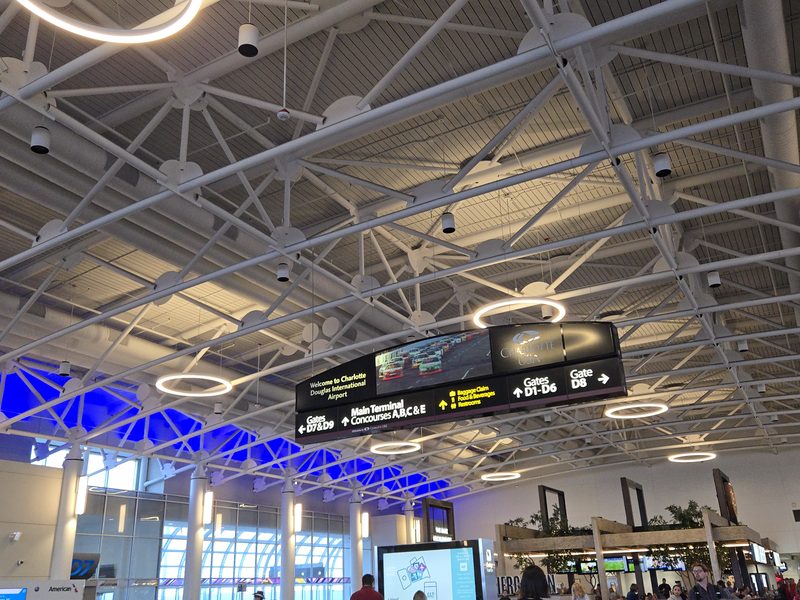
Charlotte International Airport (CLT): 👟👟👟 to 👟👟👟👟
My experience in CLT is limited to connections, so I’m unable to provide insight on walking distances between the airport entrance and the check-in counters and security checkpoints. But I can say walking distances depend on whether you are arriving on a domestic or international flight, and on the distance between your arrival and departure gates.
If your connection is domestic, the walk between most gates is reasonable, especially with the available moving walkways. The longest walks will be between Concourse E, where most regional flights arrive, and Concourses A and B. Travelers arriving in CLT after an international flight should expect a series of walks from their arrival gate to the U.S. Customs checkpoint, then to baggage claim, luggage recheck, the security checkpoint, and their departure gate.
Charleston International Airport (CHS): 👟👟👟
CHS proves that not all international airports require miles of walking. When I arrived at CHS, the walk from my arrival gate to the terminal exit (I didn’t have to stop at baggage claim) and then the ride-share station was a quick stroll, taking less than 10 minutes. On my departure day, I had a similar experience. The walk from the entrance to the security checkpoint was short, and from there, the walk to the departure gate was reasonable.
Denver International Airport (DEN): 👟👟👟👟
DEN is a large airport, but it earns 4 shoes instead of 5 because its moving walkways and train minimize the amount of walking required to navigate the terminal and concourses. I arrived at and departed from DEN from gates at the far end of Concourse C, and without those walkways and the efficient train, my reasonable walk would have turned into a trek. After baggage claim, travelers do need to walk a short distance to either the public transportation station or the ride-share pick-up lane. Note that for late-night flights, you may need to walk a bit more because fewer security checkpoints are open.
Dallas Fort Worth International Airport (DFW): 👟👟👟👟👟
This is one airport where travelers can expect to walk a lot, particularly during connections involving an international arrival. While DFW has a Skylink Train, I didn’t see any moving walkways, which would have greatly helped me cross the sizeable concourses. I’ve traveled through numerous airports in the U.S. and abroad, and DFW definitely ranks at the top for walking distances, especially since some gates require walking up or down inclines some would consider steep.
When my international flight arrived at DFW, I was shocked and exhausted by the amount of walking required from the arrival gate to the U.S. Customs checkpoint, then to baggage claim, luggage recheck, the security checkpoint, the Skylink station, and finally my departure gate. Fortunately, the Skylink train is reliable; otherwise, you’d need to add that walk between concourses to your trek.
Salt Lake City International Airport (SLC): 👟👟👟 to 👟👟👟👟
Like DEN and DFW, SLC is a sizeable airport, and depending on your gate’s location, travelers should be prepared to walk a considerable distance. My flight arrived in Concourse B, and that requires going through one of two tunnels connecting it to Concourse A and the terminal building. The tunnels are about 2/3 of a mile long, but each has moving sidewalks that reduce the amount of walking required. Once at the terminal, the walk to baggage claim and then the train station is reasonable. For departures, I found the walking distances within the terminal building to be in the 3-shoe category, but if your flight is out of Concourse B, you’ll have to contend with the trek through the tunnels.
International Airports
Heathrow Airport (LHR): 👟👟👟👟 to 👟👟👟👟👟
My experience at LHR is limited to 3 connections, where I quickly learned that you will need to walk longer distances here, especially when moving between terminals. This is a large airport with multiple terminals, and within each, gates tend to be spaced far apart. To make matters worse, gates are generally not announced until the last minute, leaving you to power-walk to your flight.
The 2 connections I had within Terminal 3 involved a lot of walking, particularly for one flight where the departure was at the far reaches of the terminal. Then there is the journey from Terminal 5 to Terminal 3. When arriving in the satellite buildings of Terminal 5 (B and C Gates), travelers need to walk from the arrival gate to a train station and then, upon arriving at the main terminal building, walk to the bus stop by the exit. I had to do this during my first connection at LHR, and it was a bit exhausting when lugging your personal item plus carry-on.
Munich International Airport (MUC): 👟👟👟 to 👟👟👟👟
I have only been to MUC once, so my experience here is limited. I arrived in Terminal 1 and, after passport control, walked to the train station that sits between the two terminals. Depending on your exact arrival gate, the walk can range from a rating of 3 to 4 shoes, but the distances felt shorter than what I encountered in LHR and later in MAD.
Madrid-Barajas Airport (MAD): 👟👟👟👟👟
MAD deserves a rating of 6 shoes because it is massive and feels like you’re walking across a small country. This is a great airport to burn off vacation calories, since getting anywhere in MAD is a hike. My flight arrived in Terminal 4 – Satellite Building, and the walk from there to the terminal exit was extensive. The satellite building is huge, and the walk from the arrival gates to passport control is considerable. After passport control, you need to walk to the satellite train station, take the train to the main terminal, and then walk from the train station to baggage claim. You finish your journey by walking to the taxi stand, which fortunately is near the exit doors.
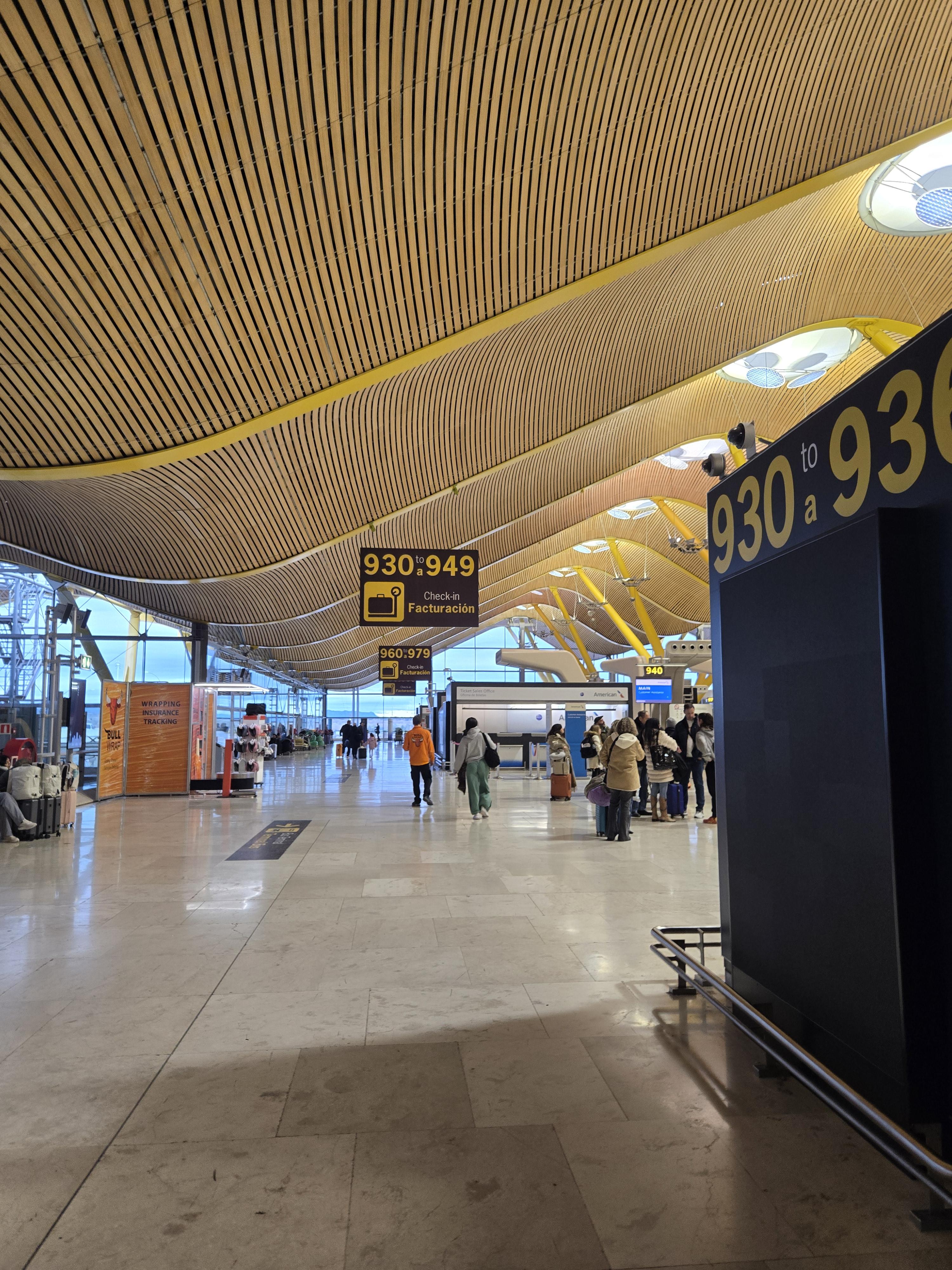
My departure from MAD required even more walking because not all check-in counters are reasonably close to the entrance (see picture at top of this guide). Once I found my check-in counter, I was surprised by the walk needed to reach the Fast Track security checkpoint and then to the train station to head to the satellite building. I had to take a break halfway through because between my bookbag (it can get heavy because of my laptop) plus a tote bag packed with souvenirs, I was exhausted. When you arrive at the satellite building, you are directed to passport control before starting your trek to your departure gate. Unfortunately, my gate was the last one towards the very end of the building.
Frankfurt Airport (FRA): 👟👟👟 to 👟👟👟👟
I unexpectedly ended up in FRA after a series of flight mishaps that left me with a 9-hour layover here. During my time at FRA, I only experienced Terminal 3, which did not feel as large as other terminal buildings I have walked through. My walk from the J Gates to passport control and the H Gates was reasonable and shorter than expected. But I was fortunate that, for this trip, my gate was closer to passport control and didn’t require the longer walk toward the end of the hallway. I did notice that reaching the airport lounges required a decent amount of walking, so between that and the longer hallways in the gate area, I rated FRA between 3 shoes and 4 shoes.
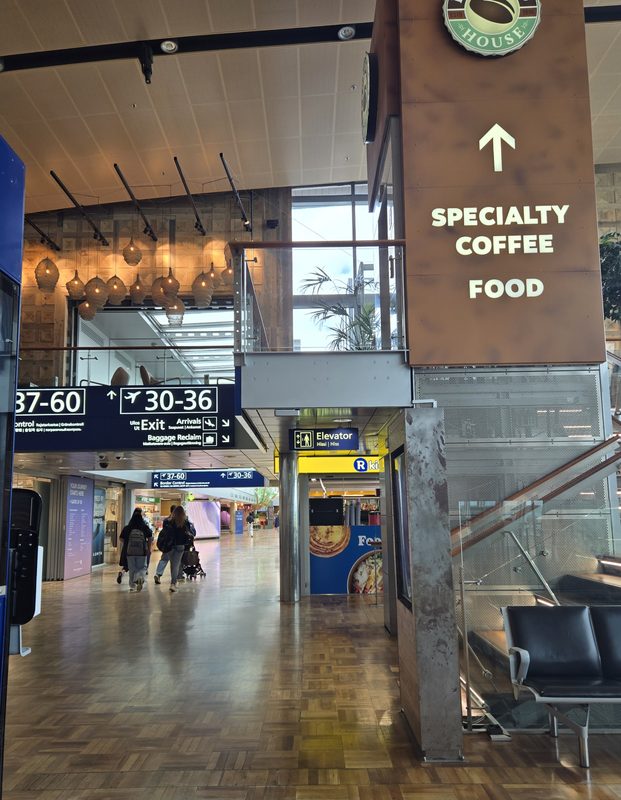
Helsinki Airport (HEL): 👟👟👟 to 👟👟👟👟
For a recent trip, I arrived at and departed from HEL, and the experiences were quite different. For my arrival, because of my unexpected layover in FRA, I arrived in the Schengen Region section of HEL and didn’t need to go through passport control, as I had already done so in Frankfurt. The walk from my gate to baggage claim, and then the taxi stands, was relatively short. HEL is also a bit easier to navigate than LHR and MAD, which helps keep the walking distances shorter and more manageable.
Departure, on the other hand, required more walking, but the upside is that compared to other European airports, all the gates are housed within one terminal building, eliminating the additional walks to train stations and bus stops. My departure journey began with my flight into HEL from Tallinn, which arrived essentially at the very end of the hallway of the Schengen Region gates. From there, I had to walk to the other end of the airport, including a stop at border control since I was boarding a flight to the U.S. While it can be considered a long walk, it is nothing compared to my experiences at LHR and MAD.
Tallinn Airport (TLL): 👟👟
TLL may be my favorite European airport solely because, despite being an international airport, it has a small footprint and requires minimal walking. The walk from the entrance to the check-in counters was short, as was the walk from there to the security checkpoint. After security, it was just a stroll to the gate area. TLL reminded me a lot of GNV: a pleasant experience without the long journeys to the check-in counters, checkpoints, and gates.
Istanbul Airport (IST):
*Stay tuned as I’ll be visiting this airport for an upcoming fall trip*
Fellow travelers, I hope you found this guide a useful planning tool for your next adventure. Remember that “regional” and “international” are just terms, not good indicators of an airport’s size or how much walking you’ll need to do. Also, keep in mind that walking distances may feel longer when you factor in jet lag, heavy bags, and travel exhaustion.
Another important thing to be mindful of is that infrastructure fails, so when planning your trip, don’t rely too heavily on the fact that an airport has a train or bus system. As I shared in my MIA blurb, the SkyTrain doesn’t always work, and when it fails, you may end up walking close to a mile, which isn’t ideal if you have a tight connection or are carrying a lot of bags.
As I continue traveling, I’ll update this guide with new airports and experiences.





Leave a Comment