

International travel is amazing, and the keys to unlocking adventures abroad are two essential documents: passports and tourist visas. Without these documents, travelers can find themselves in a situation where a country denies them entry. This guide highlights the basics of passports and tourist visas, simplifying information that can sometimes be overwhelming.
Before we begin, I would like to share a valuable tip – always check the status and condition of your passport before making any travel reservations. Make sure that it 1) will not expire before the trip and 2) meets the passport validity requirements of your destination. As for the condition, a passport showing damage, even if it is minor, may be rendered invalid.

IMPORTANT: This guide provides a general overview of passports and tourist visas. For information specific to your destination or situation, always consult an official government site or contact your country’s embassy at your destination.
Guide to Passports
Passports are a travel essential, and the process may seem complicated at first, especially for first-time applicants. The good news is that once you apply for your first passport, it is valid for 10 years, unless damaged or lost. In this section, I outline a few key passport components, and below I provide links to 2 official U.S. Government websites for more detailed information.
Official website of the U.S. Government: USA Gov
Official travel website for the U.S. Department of State: US Department of State
Adult Passport vs Child Passport
The processes for adult and child passports differ, so do not assume you can follow the same steps for both. Another key difference is validity and renewability: adult passports are valid for 10 years and can be renewed in most cases, whereas passports for children aged 16 and under are valid for 5 years and cannot be renewed.
In-Person vs Online
New applications must be submitted in person at a passport acceptance facility, while qualifying renewals can be completed online or by mail. Note that not all passport acceptance facilities take passport photos, so confirm with the location when making an appointment or before arriving.
Timeline
The U.S. Department of State offers 4 processing types: Routine, Expedited, Urgent, and Life or Death. The last two options require an appointment with a qualified passport agency or passport center not a passport acceptance facility. Urgent processing applies to travel occurring in 2 to 3 weeks, while Life or Death applies to travel occurring in less than 14 days. If the trip is in less than 8 weeks, travelers must select Expedited, which incurs an additional fee.
Passport Acceptance Facility vs Passport Agency/Passport Center
Passport Acceptance Facility: Found in most towns, with larger cities having multiple locations, and can include government offices, libraries, and post offices.
Passport Agency/Center: Managed by the US Department of State, and not every state has a location.
Passport Photos
Many passport acceptance facilities offer passport photo services, but to save time and money, travelers can take their own photo at home with a digital camera. The digital photo can then be printed for in-person appointments or uploaded for online renewals. The two links I provided above list all the photo requirements. Note that the application may be denied if the requirements are not met.
Documents
Thankfully, the amount of paperwork required for passport applications and renewals is not extensive. All the necessary forms are available on official government websites, and you can either print and complete them by hand or fill them out online. If applying in person, certain forms must be signed in the presence of staff at a passport agency or passport acceptance facility.
First-time applicants will be required to provide additional documentation. When determining your passport processing time, also factor in the time needed to locate and obtain the documents.
Key Passport Requirements
Passport Validity
Most countries require that a traveler’s passport be valid for a specified number of months beyond the planned departure date. Some countries list both a required and a recommended number of months.
Example: Let’s say a country has a passport validity of 6 months, and your trip ends on January 1st. This means that your passport must be valid at least through July 1st.
Blank Passport Pages
Countries also require that a traveler’s passport contain a certain number of blank pages, and some require those pages to be consecutive.
Example: When I traveled to Egypt, one blank page was required, whereas in Germany, two blank pages were needed.
Learn more about your destination’s passport validity and blank passport page requirements by visiting the U.S.Department of State’s International Travel site. Here, you’ll also find key information such as currency restrictions, vaccination requirements, and current travel advisories.
Guide to Tourist Visas
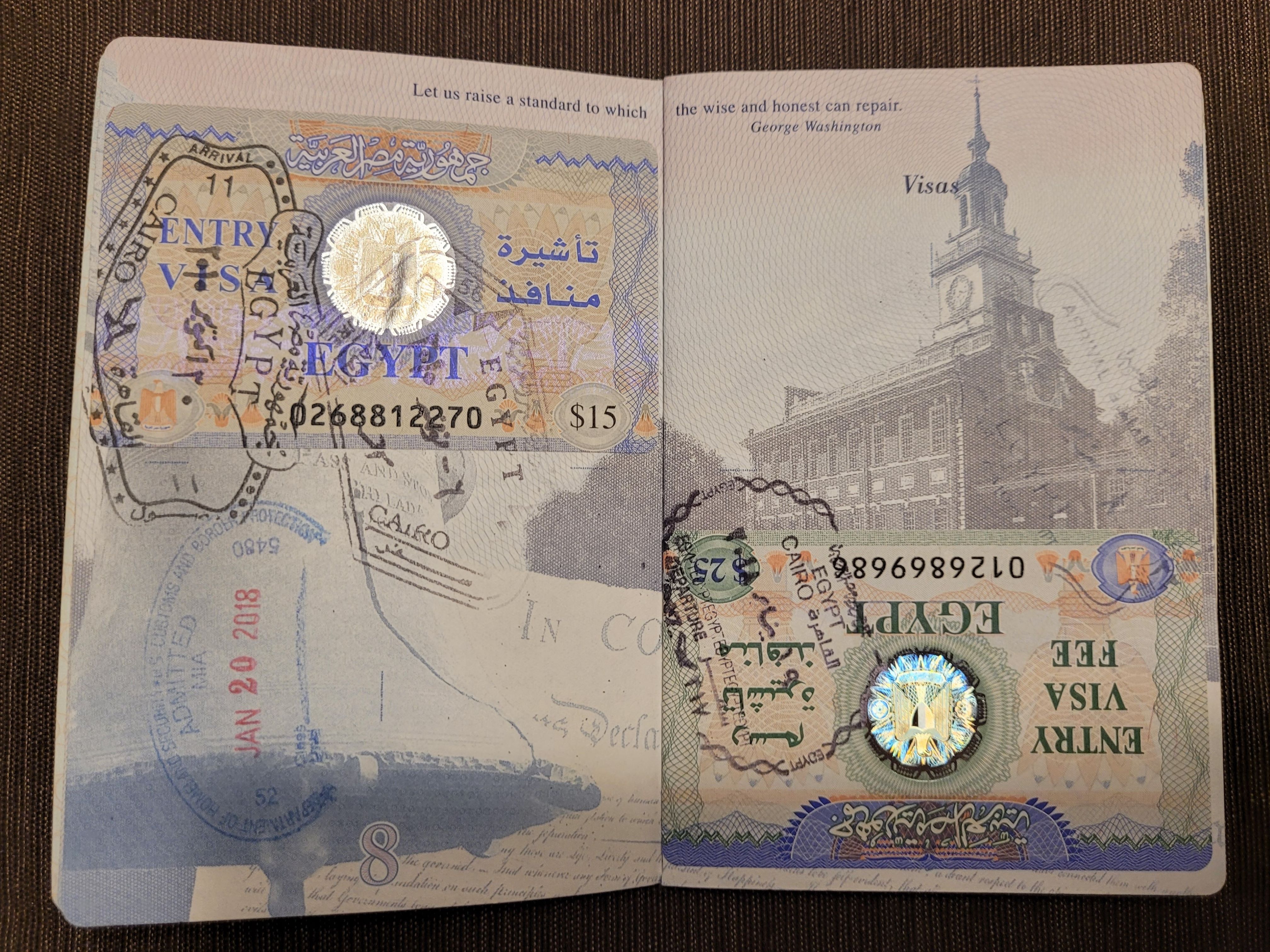
For those wondering what a tourist visa looks like, this is a photo of my old passport showing my two Egyptian tourist visas. They are a nice travel souvenir!
A tourist visa is another key requirement for international travel. There is no standard requirement, as each country sets its own rules. Some countries require a visa for all visitors, regardless of trip length, while others require one only if the stay exceeds a certain number of days.
Example: On both of my trips to Egypt, a visa was required, even though my stay was only about two weeks. For my trips to Czechia, Hungary, Germany, and Austria, a visa was required only if the stay exceeded 90 days within a 180-day period.
For my trips to Egypt, I had the option of purchasing the visas beforehand, but I opted to buy them at the airport to avoid additional fees and shipping costs. While Egypt allows most travelers to obtain a visa upon arrival, that is not the case for all countries. Some require travelers to obtain a visa before the start of their trip.
Buying the visa at Cairo International Airport was a simple and straightforward process. After landing, I walked to the designated area for tourist visas, handed my passport and payment to security personnel, and, after a few minutes, the visa was placed in my passport.

Tourist visa rules can change, so always double-check requirements before finalizing travel plans. Visit the U.S. Department of State’s website to confirm whether a tourist visa is required for your destination.




Leave a Comment