
Traveling the world is a dream for many, but rising costs can make it feel out of reach. I completely understand – life is expensive, and many of us are living within a tight budget. But here’s the good news: travel doesn’t have to remain just a dream. With the right balance of planning, realistic expectations, and strategies, those bucket-list adventures can become a reality.
In this guide, I’ll share insights, tips, and lessons learned from 35+ years of travel and trip planning to help you set goals, build a travel budget, avoid common money pits, and develop strategies.
Fellow adventurers, you too will soon be wandering the world without worries!
Understanding the Financial Side of Trip Planning

For many, understanding travel expenses and putting together a travel budget can feel complex and overwhelming. Here, I simplify matters by providing a roadmap that breaks up the process into three easy steps and highlights travel money pits that can derail your goal of making a trip more affordable.

Setting Travel Goals
The first stop on the roadmap is setting travel goals. This essential step brings those travel dreams into focus and gives a clearer picture of what you hope to experience. With goals in place, you’ll be able to build a more effective travel budget and set of strategies.
Here are some questions to help you start putting those goals together.
Purpose: This is the “why” of the trip. Explore a new place? Experience a new culture? Relax by the beach or seek an adventure? Celebrate a milestone?
Interests: Your interests help pinpoint the must-see and must-experience items versus the nice-to-have. Is your must-see an acclaimed museum or a beautiful waterfall? For a must-experience, are you looking for a well-curated history walking tour or camping under the Northern Lights? To narrow down your lists, focus on what will make you happiest and most fulfilled during the trip.
Destination: The destination will have the greatest impact on your travel budget (keep in mind that exchange rates affect affordability). Are you looking for a weekend getaway at a domestic destination or a two-week journey abroad? Interested in visiting one place or prefer a multi-city vacation?

If you need ideas for a destination, check out my “Wanderlust Unlocked: How to Pick the Perfect Destination” guide.
Travel Dates: Another significant factor affecting the travel budget is the timing of your trip. Are you planning to travel during peak season (i.e., summertime, Christmastime, etc.) or do you have the flexibility to travel during the offseason or shoulder season? For international travel, remember to consider major holidays, festivals, and special events at your destination, as these can greatly affect crowds and prices.
Travel Style: There are a few items to consider under this category. Are you looking to travel solo, journey with friends and family, or participate in a tour? Do you prefer a packed itinerary or would rather travel at a leisurely pace?
Logistics: This covers transportation and lodging. If your trip requires a flight, are you set on a specific airline or cabin? Regarding ground transportation, will you be renting a vehicle or relying on ride-sharing, taxis, or public transit? When it comes to lodging, is it agreeable to stay in simpler accommodations (i.e., 3-star hotel, modest tent when camping, etc) or do you prefer lodging that includes more amenities and luxuries?
Budget Priority Areas: For this category, you’ll need to determine where you’re willing to save to afford a few splurges. Affordable travel is all about trade-offs and prioritizing what truly will make your trip memorable. Are you okay with staying in more modest accommodations to travel in business class? Or do you prefer to save in dining and experiences to lodge at a 5-star hotel?
Building a Travel Budget
After you have jotted down a few goals, it’s time to move to the second stop on our roadmap – the travel budget. This task will help capture costs and ensure you stay within your overall budget. I know that for some, putting together a budget may seem intimidating, but all you need is a simple table, which can be created with a spreadsheet or the old-fashioned way, pen and paper.
This is an example to help you get started. The “Notes” column is a good way to keep track of deadlines and possible additional fees. If you want, you can add a “Category” column to your table to see how much you’re spending on air travel, lodging, meals, etc.
| Item | Cost | Notes |
| Passport Renewal | $130 | Renew soon to avoid $60 expedited fee |
| Flight to Destination | $1200 | Checked luggage, if needed, $40/each way |
| Art Museum | $30 | Search for a discounted city pass |
| Historical Walking Tour | $50 | Interested but not a must-experience |
For my travel budgets, I use Google Sheets because it is cloud-based, making it easy to access while traveling. Having this access allows me to monitor my budget throughout the trip and stay mindful of my spending. Also, I add expenses to the spreadsheet along the way to help me track and reconcile charges while planning and then traveling. At the end of the journey, I review the spreadsheet to identify where I can improve my budgeting and spending for the next trip.
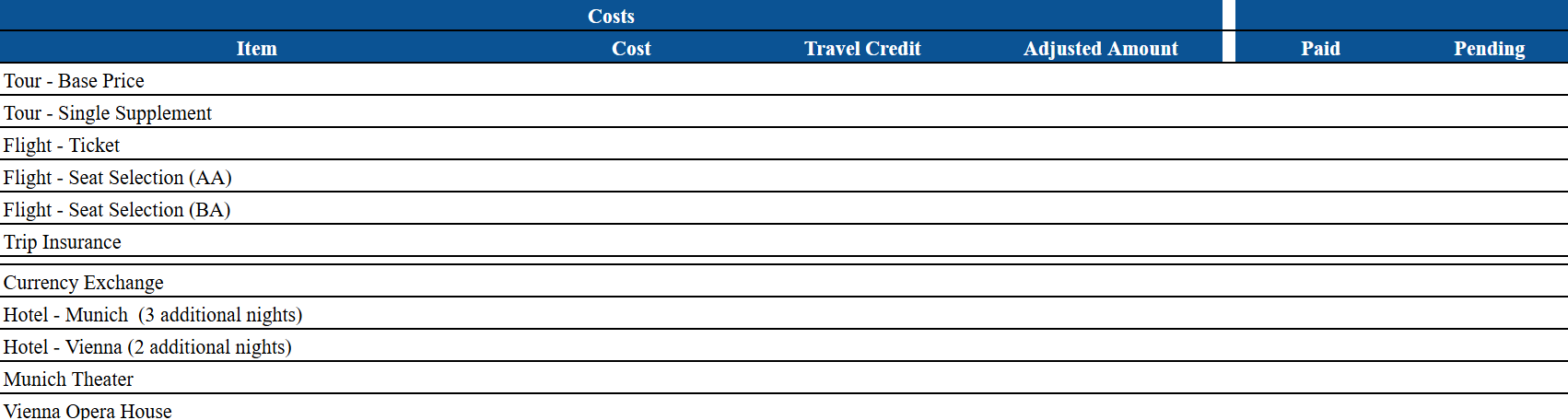
This is a snippet of the spreadsheet that I used to prepare my travel budget and track expenses for my recent trip to Europe. I added a column for “Travel Credits” to record discounts, credits, and rebates that reduced the original cost. I also included 2 columns to track what I had paid for each item, such as deposits, and the pending balance.
Once you are ready to start budgeting, the following are expenses that should be included, or at least considered, when planning your trip.
Required Documentation: For domestic trips within the U.S., in most instances, all that is needed is a Real ID-compliant driver’s license. For international travel, a passport is required, and depending on your destination, you may also need a tourist visa or an entry authorization, such as ETA.
The cost of a passport depends on whether it is your first or a renewal, as well as any applicable fees or expedited service. As of 2025, expect to pay between $130 and $225 for a passport. The cost of a tourist visa varies widely, from as low as $25 to a few hundred dollars. It just depends on your destination.
Insurance: I highly recommend purchasing traveler’s insurance, especially for an international trip. This insurance is a great safety net if you have a medical emergency abroad or experience trip disruptions such as flight delays or lost luggage. Travel insurance generally costs a few hundred dollars, with the price depending on the level of coverage selected. It is a worthwhile investment that can save you thousands in the end.
Contingency Fund: Accidents and unforeseen circumstances happen while traveling, so it is wise to set aside 10% to 15% of your overall trip budget as an emergency fund. This can help cover unexpected expenses, such as a visit to a medical clinic or one night’s lodging if your flight is cancelled.
Destination: An essential point to consider when budgeting for international trips is the exchange rate. Costs for meals, admission tickets, and ground transportation can really add up when factoring in the exchange rate, particularly in destinations with a currency stronger than the U.S. dollar.
Air Travel: When it comes to air travel, there are many associated costs that travelers often forget to include in their travel budget. This includes fees for checked luggage, airport parking, and transportation services to/from the airport. The cost of checked luggage keeps increasing, but some airlines do offer a discount if the fee is paid online.
Tours: If participating in a tour, I highly recommend doing a deep dive to understand what expenses are included in the tour price. This applies to both multi-day tour groups and one-day walking tours and day trips. In my destination guide about “Selecting the Perfect Tour Group“, I go into details about costs that need to be considered, such as airport transfers, additional activities during your free time, non-tour meals, gratuities, and possible cancellation fees. One important point to consider, which I discuss in the guide, is that many low-cost tours offer only the bare minimum, leading to numerous out-of-pocket expenses.
Lodging: As with air travel, there are many costs associated with lodging that travelers may forget to list in their travel budget. The more common additional expenses are on-site parking, amenities fees, and in-room snacks and mini bar. Some hotels may charge guests a fee for internet access or an in-room safe. Also, do not forget to include gratuity for housekeeping and bellhops.
Ground Transportation: This category covers public transportation, private vehicles, ride share services, and taxis. If renting a vehicle, you’ll need to consider charges such as fuel, tolls, additional insurance coverage, and special features like satellite radio or winter tires. When it comes to taxis, some cities post local rates, so all you need to estimate is the gratuity. For ride-share services, it is best to overestimate, as many factors (e.g., vehicle type, distance, surge pricing, etc.) affect the base fare. Public transportation will be the more affordable option, and it is best to purchase a multi-day or weekly pass if staying in the same city for a few days.
Meals: It is easier to budget for meals because many cafes and eateries publish their menus online. The only thing to consider is additional service fees and gratuities. To budget for meals, simply multiply a meal (i.e., dinner) by the number of days you’re traveling. Also, note that in some countries, restaurants do not allow splitting or sharing plates, so if traveling with friends and family, it is best to budget for individual meals.
Admission Fees: When purchasing attraction or theatre tickets for an international trip, remember to factor in the exchange rate. And for museums and historical sites, don’t forget to include extras like audio guides or guided tours. Some cities offer passes that cover admission to several attractions, so if you plan to visit multiple sites during your trip, this is a good way to save money.
Technology & Safety: If traveling abroad, budget for essentials such as plug adapters and dual-voltage chargers or electronics (e.g., hair straighteners, electric shavers). I also recommend setting aside money to purchase a wallet and passport holder with RFID protection, which adds an extra layer of security while traveling.
Miscellaneous: It’s a good idea to budget for extras, such as purchases from a gift store or convenience store (in case you forgot to pack something, like me, who always forgets the toothpaste!). The miscellaneous category covers small, unplanned expenses and helps you stay within your planned budget.
Avoiding Travel Money Pits
Years of travel have taught me that the world is full of money pits, and it’s easy to fall into them if you’re not careful. Avoiding the common pitfalls below can help you stretch your budget, save hundreds of dollars, and enjoy a less stressful journey.
Planning: In recent years, I have noticed an increase in travel-planning dashboards, online services, and mobile apps that can cost hundreds of dollars or more. While these tools may be helpful, in my opinion, they are not a necessity, especially when trying to limit costs. There are abundant free resources available online and through mobile apps that travelers can use to plan their trip.
My go-to tools for trip planning are Google My Maps and Google Sheets, two free resources that can be easily accessed anywhere. I use My Maps to map out my itinerary visually, and then use Google Sheets to create a comprehensive workbook that includes worksheets for trip budget and expenses, itinerary, packing checklist, and trip to-do list.
Another money pit related to this category is waiting until the last minute to start preparing for your trip. While some travelers love the thrill of a last-minute trip, delaying planning can lead to missed deadlines, lost discounts, and limited availability for flights, lodging, and experiences. For example, if you wait too long to renew your passport, you may need to pay extra for expedited processing. With flights, waiting until the last minute may mean higher airfares, plus preferred cabins and seats may not be available. When admission tickets sell out, some may be available through a 3rd-party reseller, but usually at a higher price and possibly without the option to cancel for a refund.
Advantages of booking early are lower prices, special offers, and better seats on flights and for shows. For my 2025 spring trip to Europe, I scored an incredible deal on a business-class seat when I booked the flight about 6 months beforehand. When visiting Prague last year, I was able to get a front-row seat to a classical concert by purchasing the ticket 4 months in advance.
Air Travel: A major money pit associated with flights is purchasing seat upgrades that add little to no real benefit. Before booking a flight and paying for an upgrade, it is worth doing some research. My travel guide on “Landing the Perfect Plane Seat” lists resources that can help you evaluate seat comfort, legroom, and location before you book.
A second money pit related to air travel is airport purchases. Airports are notorious for their significant markups on everything from food and beverages to toiletries. I always travel with a refillable water bottle, and for longer trips, I bring single-serve snack packs (nuts, dried fruit, granola bars, etc.). If you forget a toiletry, most hotels provide basic amenities like toothpaste and toothbrushes, or you can stop by a convenience store at your destination.
For international trips, be mindful of the currency exchange booths at airports. These kiosks tend to offer unfavorable exchange rates and charge a higher service fee. It’s better to request foreign currency from your bank before your trip or withdraw cash from an ATM at your destination.
Lodging: When it comes to accommodations, one of the biggest money pits is fees, primarily “resort fees”. While city taxes and tourism fees are standard in many destinations, resort fees are added charges meant to cover amenities such as gyms, pools, Wi-Fi, exercise classes, or shuttle services. Before booking your stay, always check for additional fees and what they include, especially if you have no interest in the extra amenities. Some hotels list that information on their websites, while others require you to contact them directly.
Similar to air travel, upgrades may not necessarily provide a useful benefit. Many hotels try to entice travelers with buzzwords like beach view or spacious corner room, but sometimes those descriptions are just a gimmick. Once, while visiting Cocoa Beach, Florida, I booked a room labeled “ocean view” and quickly discovered the photos on the hotel’s website were not accurate (I could only see a sliver of ocean between two buildings). And those spacious corner rooms are usually just a tad bigger, not enough to make a noticeable difference, especially if traveling solo.
A final money pit is room service. While convenient and a nice luxury, room service comes with high markups and several fees. During my trip to Denver, I discovered that using DoorDash or Uber Eats was a more affordable option than ordering room service (a bonus: more dining options). Internationally, many cities have local restaurants that offer delivery, which is again a cost-saving alternative.
Tours: Always review the itinerary carefully and be mindful of activities that include visits to shops or villages. As I wrote in my travel guide on selecting tour groups, these activities are not always thoughtful, cultural immersion experiences. Sometimes, they are gimmicky “tourist trap” visits, where travelers feel pressured to make a purchase.
For tours that include outdoor activities, such as camping, glacier walks, or cave visits, check whether equipment rental is included or requires an additional fee. Extra charges for specialty gear (tents, helmets, crampons, etc.) can really add up, so it may be worth choosing a tour that covers these items, even if the base price is slightly higher.
Meals: When traveling abroad, try to avoid restaurants in major tourist areas or near attractions, as they tend to charge more than eateries catering to locals. Also, don’t assume that items brought to the table, like water carafes, bread, or tortilla chips, are complimentary. In many countries, extras that are free in the U.S. are charged extra abroad, so it’s always a good idea to ask the server before accepting them.
Admission Fees: In the previous section, I mentioned that city passes can be a good way to save money. However, they can also be a money pit. Some passes mix top attractions and experiences with lesser-visited sites that may not be worth a traveler’s time, especially if they have limited time in a city. Before purchasing a pass, make a list of the attractions and experiences you’re genuinely interested in, along with their costs without the pass. Compare the overall total on your list to the price of the pass, and if the pass offers a significant savings, it’s a worthwhile investment. You can visit my “Denver CityPASS Guide” to see how I determined that the pass was a good value for my trip to Denver.
Miscellaneous:
- Phone Plans – Roaming charges are one of the biggest travel money pits, and can cost you hundreds of dollars. It’s best to purchase an international pass or an eSIM if your mobile phone plan doesn’t include international coverage with unlimited data. Don’t forget to turn off data roaming before traveling in your phone’s settings!
- Foreign Transaction and ATM Fees – If traveling abroad, it is highly recommended to get a credit card or debit card that does not charge foreign transaction fees. The same goes for ATM cards. These fees can really add up and account for a large portion of your trip expenses.
- Souvenirs – Souvenirs are a great way to remember a trip, but be mindful of both the quality and your budget. In terms of quality, many souvenirs sold in gift shops and kiosks near tourist attractions are generally not locally made and of poorer quality. Some of the best souvenirs I’ve purchased have come from local markets like Budapest’s Central Market Hall and Munich’s Viktualienmarkt.
- Top 10 Travel Must-Haves – The internet is filled with lists such as “Top 10 Travel Essentials” or “Items Needed for Air Travel”. A lot of times, those lists are unrealistic or commission-based, leading unsuspecting travelers to spend hundreds of dollars on unnecessary items that will get little to no use. Don’t stress with the packing – all you need is clothes, basic toiletries, and prescriptions; if you forgot to pack something, most of the time you’ll be able to buy it at your destination.
Developing Travel Strategies
The final step on our roadmap is turning your goals and budget into actionable strategies that will help you save money and turn that dream vacation into a reality.
Creating a Planning Timeline: When it comes to trip planning, there are two key factors to consider: the booking window and deadlines. The booking window is the optimal time frame to reserve flights and lodging. In general, it’s best to book international flights 3 to 8 months before departure and domestic flights 1 to 3 months before departure. Of course, if your trip falls during a busy travel season, it’s wise to book the flight sooner rather than later. When it comes to lodging, research shows that at least 2 months before a trip is recommended, but for popular destinations, holidays, and peak travel season, 6 to 12 months is ideal.
Deadlines are also crucial, and missing them can turn into money pits. I highly recommend that travelers jot down important dates for passport renewals, tourist visas, travel insurance, cancellation deadlines for lodging and tours, deposit due dates, and excursion bookings.

Important to note that if interested in the “Cancel for any Reason (CFAR)” coverage, most insurers require that you purchase the policy and add the coverage within 1 to 3 weeks of making the first trip payment or deposit. Missing this timeframe means missing out on CFAR.
Setting Aside Money: A simple yet effective way to save for travel is to set aside a small portion of your paycheck. I understand that this may not be feasible for everyone, but even modest amounts can go a long way. For example, saving $25 from a bi-weekly paycheck adds up to $650 after a year. While it may not seem like much, those $650 can cover a domestic flight, several museum tickets, or a memorable bucket-list experience.
To make the process easier, consider opening a high-yield savings account (your travel fund) and have your paycheck contributions automatically deposited into it. The interest earned may be small, but every little bit helps stretch your travel budget and brings you one step closer to the dream adventure.
Earning Airline Miles: Airlines today offer travelers many ways to earn airline miles and loyalty points (for status) outside of flying. I published a special guide, “Prepare for Departure – Guide to Earning Miles & Loyalty Points“, which highlights practical ways travelers can earn miles by doing everyday activities like grocery shopping, online shopping, or dining at restaurants.
Another excellent way to earn airline miles is by taking advantage of the sign-up bonus offered by travel credit cards and airline-affiliated cards. These bonuses are awarded as airline miles or points redeemable for a statement credit that can offset all or part of the cost of a flight. For travelers just starting to earn airline miles, sign-up bonuses are a great way to jump-start earnings and boost their balance.
Selecting Lodging: Choosing the right accommodation can lead to significant savings in three different ways: nightly rates, transportation, and time. Following the guidance outlined in the travel budget and money pits sections, plus reserving during the ideal booking window, can help travelers find lower rates while avoiding unnecessary fees. Other ways to save money on lodging include booking directly and reaching out to see if they are running any specials. Hotels don’t always publish their offers!
To save on transportation and time, the key is to choose a centrally located hotel close to attractions and restaurants. Having places within walking distance or a quick bus or train ride away reduces the cost of public transportation, especially if you did not purchase a transit pass. If driving, a centrally located hotel can help reduce expenses, such as fees for parking meters and garages.
Location also plays a major role in saving travelers’ time. As the saying goes, time is money, and when you’ve invested hundreds or thousands of dollars in a trip, the best use of your time is getting to experience the sights and sounds of the city, not commuting from your hotel each morning. Another excellent advantage of a centrally located hotel is arriving at popular attractions earlier, allowing you to beat the long lines and crowds.
Never underestimate the value of a centrally located hotel. For my trips to Denver and Charleston, my hotels were within walking distance of many attractions, and the others were just a short bus or Uber ride away. This allowed me to explore two to three sites per day during those brief weekend trips! On my recent European trips, the tour company selected lodging in the heart of the city, which maximized my free time by keeping me within walking distance of many must-see sites.
Saving on Meals: Eating out every day while on vacation can get really expensive, especially when traveling with a family. These are a few of the ways I save money on dining while traveling. First, I embrace the picnic-style meals. I stop by a local market and purchase a few food items, which I then enjoy at a park or back at the hotel. I’m able to savor local cuisine without the costs associated with restaurants (mark-ups, service fees, gratuities).
My second money-saving habit is that I tend to have two major meals: breakfast and a late lunch/early dinner. I start by filling up on the hotel’s breakfast and taking fruit to eat later. Around mid-day, I enjoy the fruit along with snack packs (usually single-serve nut mixes) and a granola or protein bar. After I’m done sightseeing, I head to a restaurant that is either still serving lunch or offering an early bird dinner special.
Another great way to save on meals is by selecting accommodations that offer all-you-can-eat continental breakfasts. These breakfasts not only save you money in the long run but are also convenient and time-saving. Hotel breakfasts let you enjoy a hearty meal with unlimited beverages without waiting in line or paying a gratuity. As a bonus, many offer fruit, granola, or snack bars that you can take for an afternoon snack!
Using Gift Wishlists: One easy way to save money is by creating a travel-themed wishlist to share with family for your birthday or during a gift-giving holiday. Last year, for Christmas, I made an Amazon wishlist with travel items like refillable water bottles, mini journals (to take notes for this website), a pouch to store and organize chargers, and books to enjoy reading on flights.
Other great items to include are a toiletry bag, travel-sized laundry detergent packets and wipes, an RFID-blocking travel wallet or passport holder, packing cubes, or a travel umbrella. These smaller purchases can add up quickly, and requesting them as gifts allows you to save your own money for the actual trip.

Fellow adventurer, I hope you found this guide inspiring, empowering, and helpful as you begin planning your dream trip. The process may seem overwhelming at first, but with each journey, you’ll gain confidence and experience and soon will be writing your own travel guides!
I’d love to hear from you! In the comments below, share your favorite travel-planning and budgeting tips.




Leave a Comment